Calorie Surplus vs Maintenance: How TDEE and +5–15% Help You Gain Weight Without Excess Fat
A calorie surplus means eating more calories than your body uses. It is the setup used for weight gain, muscle gain, and demanding strength-training phases. The key is not just eating more, but choosing the right surplus and adjusting it when progress changes.
The simple definition: more energy in than energy out
Calories measure the energy in food and drink. Your body uses that energy all day, not only during workouts, but also for breathing, blood circulation, digestion, walking, chores, and recovery. When calorie intake stays higher than total energy expenditure over time, the extra energy creates a calorie surplus.
In fitness language, this is often called a bulking phase, especially when the goal is to gain muscle. But a surplus is not only for bodybuilders. It can also help athletes with high training demands, people who struggle to gain weight, and anyone who needs body weight to move upward in a controlled way.
Surplus, deficit and maintenance are three different states
The easiest way to understand the concept is to compare it with the other two energy-balance states: calorie deficit and calorie maintenance. That gives three clear categories, and the difference is simply the relationship between what you eat and what you expend.
| Energy state | Intake versus expenditure | Typical goal | Expected direction |
|---|---|---|---|
| Calorie deficit | You eat fewer calories than you expend | Weight loss | Body weight tends to decrease |
| Calorie maintenance | You eat roughly the same calories you expend | Maintain current weight | Body weight stays broadly stable |
| Calorie surplus | You eat more calories than you expend | Weight gain, muscle gain, performance support | Body weight tends to increase |
A surplus does not automatically mean all gained weight will be muscle. Weight gained in a surplus can be fat, muscle, or usually some of both. The size of the surplus, your training, protein intake, sleep, and consistency all influence the result.
Why TDEE matters before adding calories
Before you choose a surplus, you need a baseline. That baseline is commonly called TDEE, or total daily energy expenditure. It is the total amount of energy your body expends in a day. A simple way to build a surplus is to first estimate TDEE, then decide how far above it to eat.
Personalized Weight Loss and Activity Planner — Create a customized plan to reach your target weight by calculating the specific calorie and physical activity levels you need.
The three parts of energy expenditure
Energy expenditure is often explained through three types. Resting energy expenditure is the energy your body uses at rest for basic functions such as breathing and blood circulation. Diet-induced energy expenditure is the energy used for digestion, metabolism, absorption, and storage of nutrients. Activity energy expenditure covers movement, from formal training and sports to household chores and walking.
This is why two people of the same body weight may not need the same calories. A person with a physically active job, regular strength training, and a high daily step count may have a much higher TDEE than someone of similar size who is mostly sedentary. A calorie surplus is therefore personal, not universal.
If you are eating far below maintenance, increase gradually
If your current intake is significantly below your estimated TDEE, jumping straight into a large surplus may feel uncomfortable or hard to sustain. Some people need to increase intake over a few weeks or more before they start the surplus. This gradual approach can make digestion, appetite, meal planning, and training fuel easier to manage.
A slower ramp-up also makes the plan easier to repeat. Add calories in meals you can keep, keep protein steady, place carbohydrates near training when useful, and judge progress from weekly trends rather than one unusually high or low day.
How to calculate a useful calorie surplus
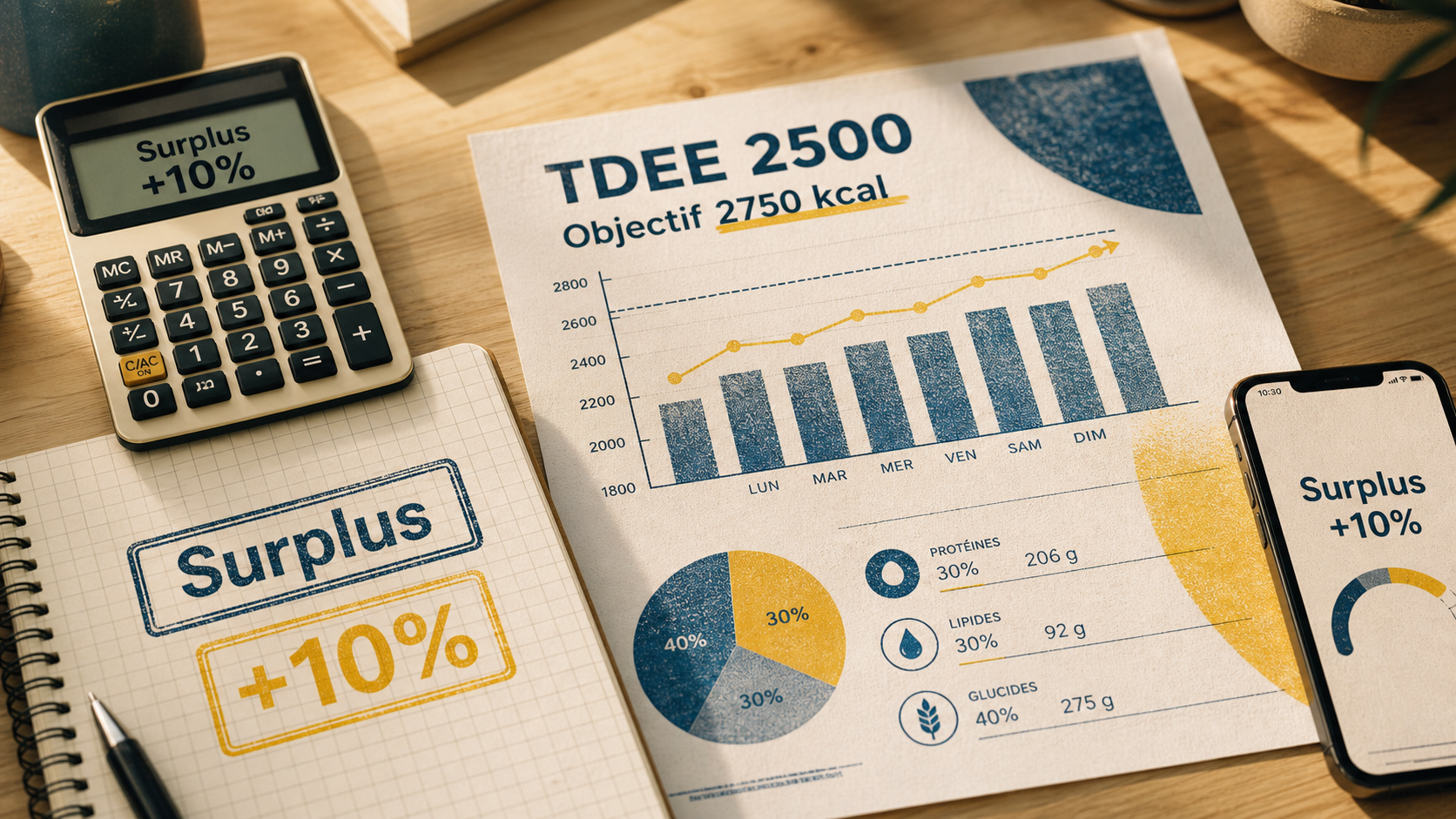
Once you have an estimated maintenance intake or TDEE, add a controlled amount of calories. A small surplus of +5–15% is a useful starting point to limit fat gain. This range gives enough extra energy to support weight gain without turning the process into an uncontrolled bulk.
A worked example with numbers
A strength athlete with a TDEE of 2,600 kcal adds +300 kcal to reach 2,900 kcal for 8 weeks. In that example, protein intake stays at 1.8–2.0 g/kg, with checks of weight, waist circumference, and performance every two weeks.
You can use the same logic even without a formal calculator:
- Estimate your TDEE or observe your maintenance calories from stable body weight over time.
- Choose a modest starting surplus, such as +5–15% above maintenance.
- Set a daily calorie target and keep it consistent enough to evaluate.
- Track body weight, waist circumference, and training performance.
- Adjust after enough data, not after one random weigh-in.
Fixed calories or percentage: which is better?
A fixed increase, such as +300 kcal, is simple and easy to apply. A percentage increase scales better for different body sizes and activity levels. For example, +10% for someone maintaining at 2,000 kcal is +200 kcal, while +10% for someone maintaining at 3,000 kcal is +300 kcal. Both methods can work; the key is whether your weight, waist, and performance trends match your goal.
If you use a calorie surplus calculator, treat its result as a starting estimate rather than a final answer. Calculators cannot perfectly know your daily movement, training intensity, digestion, or adaptive changes. The real check is the combination of your planned intake and your measured response over several weeks.
Building muscle while limiting fat gain
A moderate, controlled surplus with sufficient protein helps gain lean mass while limiting fat gain. The surplus provides extra energy, but muscle gain also needs a reason for the body to build muscle, usually progressive strength training, adequate recovery, and enough protein.
Keep protein stable and carbohydrates high enough for training
Protein is usually kept in the range of 1.8–2.2 g/kg. That does not mean protein is the only nutrient that matters. Carbohydrates help training performance, especially when sessions are demanding. Fats, fiber, and micronutrients also matter because a surplus built only from low-quality, low-fiber foods can leave you feeling sluggish and make digestion harder.
A practical surplus plate might include a protein source, a carbohydrate source, a fat source, and fruit or vegetables. Examples include rice with chicken, olive oil, and vegetables; oats with milk, fruit, and nut butter; or potatoes with eggs, avocado, and salad. Calorie-dense foods can help, but bulking does not need to mean ignoring nutrient density.
Use the right rate of gain
To reduce unnecessary fat gain, a typical weekly weight gain range is 0.25% to 0.5% of body weight. There is also a useful adjustment threshold when weekly weight gain exceeds 0.5% of body weight. If weight is rising much faster than planned and waist circumference is increasing quickly, the surplus may be too aggressive.
Light cardio can still fit into a surplus if total intake remains above expenditure. It can support cardiovascular health and recovery without preventing weight gain. The issue is not cardio itself. The issue is failing to replace the calories it uses when it starts to pull you back toward maintenance.
Tracking, adjusting and knowing when to change course
A calorie surplus works best when it is treated as a feedback loop. You set a target, follow it consistently, measure what happens, then make a small adjustment if needed. Reviewing waist circumference and performance every 2–3 weeks is often more useful than reacting daily.
What to track each week
Track body weight using weekly averages rather than one weigh-in. Use waist circumference to see whether body-size changes are accumulating around the midsection. Watch training performance for strength, recovery, and session quality. Keep protein intake consistent, and pay attention to digestion and appetite so the plan remains sustainable.
Common mistakes to avoid
The first mistake is making the surplus too large because faster seems better. Rapid gain often increases the likelihood of fat gain. The second is treating a surplus as permission to rely mainly on junk food. Calorie-dense foods can help, but micronutrients and fiber still matter. The third is ignoring training quality. Without a strong resistance-training stimulus, the extra energy is less likely to support lean mass gain.
Finally, avoid changing calories every day based on emotion. If weight is not moving after a few consistent weeks, add a small amount. If weight is rising faster than the 0.25% to 0.5% of body weight weekly range and waist circumference is climbing quickly, reduce the surplus slightly. A good calorie surplus is not the biggest one you can tolerate, it is the one that moves you toward your goal with the least unnecessary trade-off.

- Compléments alimentaires antioxydants : plus concentrés, pas forcément plus utiles - 12 octobre 2026
- Compléments alimentaires : utiles en cas de carence, risqués en cas de cumul - 8 octobre 2026
- Plusieurs compléments alimentaires peuvent être associés, à condition de vérifier les dosages - 7 octobre 2026